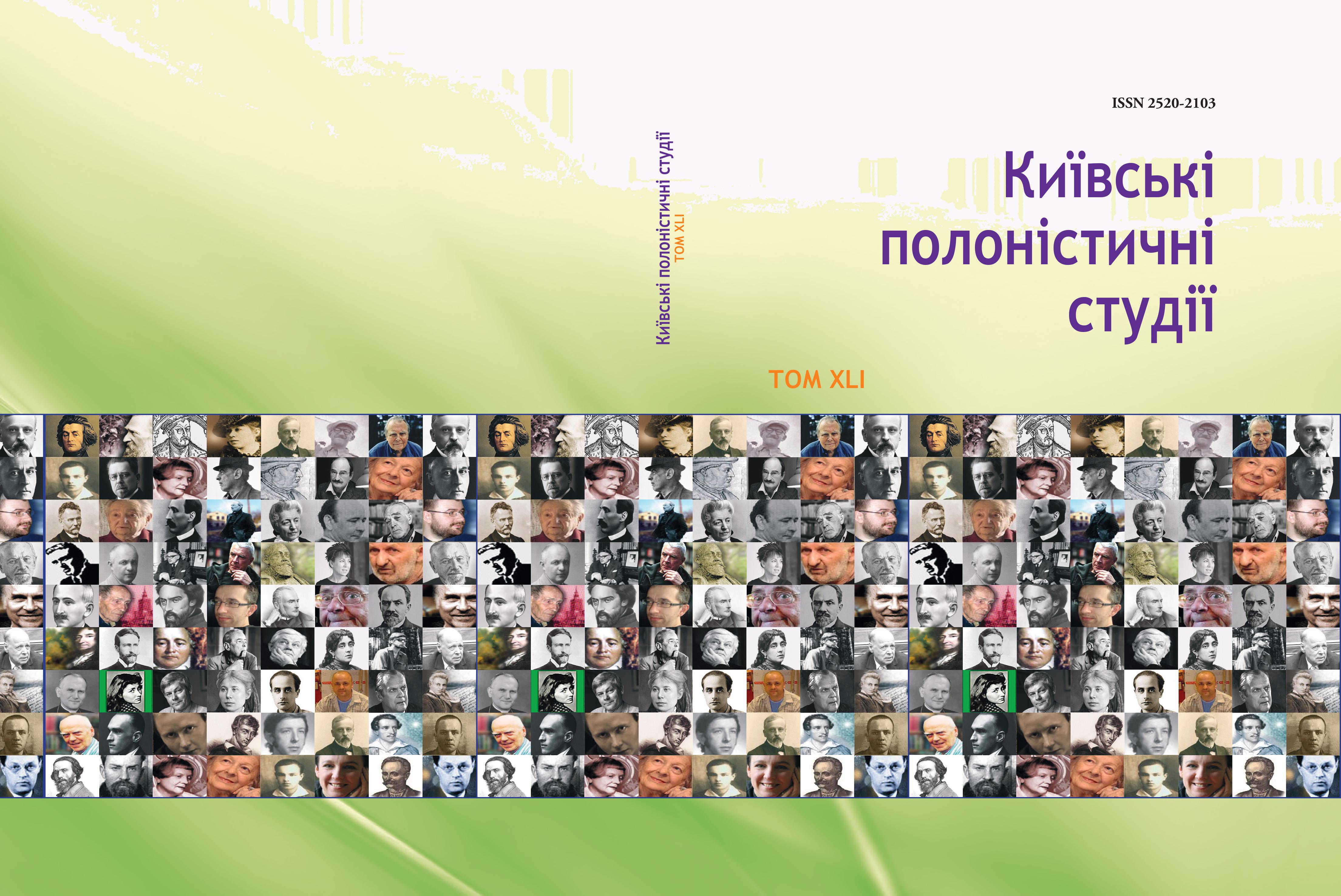
Comparative and Translational Challenges for Contemporary Polish Literary Studies in the Context of Polish-Ukrainian Relations
DOI:
https://doi.org/10.17721/psk.2025.41.63-79Keywords:
canon, Polish studies, literary studies, translation, translation studies, Polish-Ukrainian relationsAbstract
This article proposes that the concept of contemporary Polish literature’s literary canon (including recent literature) should be defined in a relational manner, accounting for this canon’s communicative function in international relations—in this case, Polish-Ukrainian relations. The canon encompasses a time-tested collection of literary texts and a set of books that facilitate understanding of the literary past while creating a specific place for mutual understanding in our place and time, indicating the existence of an anthropological community. In this sense, the literary canon should expand successively. Translations and translation research are key contributors in this formation, and it in turn fosters comparative studies, which are among Polish literary studies’ most important challenges. A comparative reflection on national literatures — including Polish and Ukrainian — in the context of the borderland experience, viewed through a contemporary lens, requires addressing questions about whether, and if so, what models of coexistence have been developed; what their artistic representations entail; and what place the individual occupies within them. Do these cultures remain separated, in a state of conflict, or in a positively understood form of contact? Is collaboration between them possible, and if so, on what grounds? Does it stem from processes of assimilation and integration imposed by a dominant group and its language, or from dialogical integration grounded in partnership and mutual respect? This example – one among many – clearly demonstrates that any reading of contemporary Polish literature is incomplete without reference to the Ukrainian context, just as earlier it would have been impossible to fully understand selected poems by Bolesław Leśmian, essays by Jerzy Stempowski, prose by Leopold Buczkowski or Włodzimierz Odojewski, or the poetry and fiction of Józef Wittlin without that same context. Without reference to the works of Yevhen Malaniuk and the legacy of the “Executed Renaissance,” the poetic and ideological dimensions of Józef Łobodowski’s writings would remain obscure; without engagement with Yurii Andrukhovych’s oeuvre, the prose of Andrzej Stasiuk would lose part of its depth.
References
100 wierszy wolnych Ukrainy. (2022). Tłum. B. Zadura. Wrocław: Biuro Literackie.
30 wierszy zza granicy. Młoda poezja ukraińska. (2012). Tłum. A. Kamińska. Rzeszów: Podkarpacki Instytut Książki i Marketingu.
Bloom, H. (2019). Zachodni kanon (Tłum. B. Baran, M. Szczubiałka). Warszawa: Aletheia.
Cząstki pomarańczy. Nowa poezja ukraińska. (2011). Tłum. A. Kamińska. Kraków: Wydawnictwo Ha!art.
Czetyrba-Piszczako, M. (2017). Przegląd literatury ukraińskiej w przekładach na język polski po 1989 roku. Acta Polono-Ruthenica, 22(2), 103–115.
Debata Kanony literackie wobec wyzwań współczesnej kultury z udziałem E. Paczoskiej, Ż. Nalewajk, P. Sadzika, M. Łazińskiego, K. Biedrzyckiego, B. Szleszyńskiego, M. Kuziaka i W. Dudzika. (2025). Tekstualia, 4(83).
Deklaracja w sprawie niepodległości Ukrainy. (1977). Kultura, 5, 66–67.
Europejski kanon literacki. (2012). E. Wichrowska (red.). Warszawa: Wydawnictwa Uniwersytetu Warszawskiego.
Jarzębski, J. (brak daty). Metamorfozy kanonu. Znak, 7(470).
Kamińska, A. (2023). Pokój z widokiem na wojnę. Brzeg: Stowarzyszenie Żywych Poetów.
Kamińska, A. (2024). Pokój z widokiem na wojnę (t. 2). Brzeg: Stowarzyszenie Żywych Poetów.
Kamińska, A. (2025). Pokój z widokiem na wojnę (t. 3). Brzeg: Stowarzyszenie Żywych Poetów.
Kanon i obrzeża. (2025). I. Iwasiów, T. Czerska (red.). Kraków: Universitas.
Kozicka, D. (2022). Kanon – (nie)ruchomości. Forum Poetyki, 28–29.
Mitzner, P. (2014). Do Rosji. Tekstualia, 4(39).
Piszą więc żyją. Pierwszych sto dni wojny. (2022). Tłum. B. Zadura. Wrocław: Biuro Literackie.
Regiewicz, A. (2000). Zasada tranzytywności w edukacji humanistycznej. Popkultura i kanon. Podstawy Edukacji. Dyskusje wokół kultury popularnej jako edukacyjnej przestrzeni, 13, 13–25.
Schallcross, B. (2014). Requiem dla kanonu? Szczególny przypadek kanonu transatlantyckiego (Tłum. A. Skrabińska-Zielińska). Teksty Drugie, 4.
Snyder, T. (2011). Skrwawione ziemie. Europa między Hitlerem a Stalinem (Tłum. B. Pietrzyk). Warszawa: Świat Książki.
Szaruga, L. (1980). Tłumaczenie. W: Wiersze (s. 149). Warszawa: WLiK.
Szaruga, L. (2022). De bellum (część pierwsza). Tekstualia, 4(71).
Szaruga, L. (2023a). De bellum (część druga). Tekstualia, 1(72).
Szaruga, L. (2023b). No i co z tego (część pierwsza). Tekstualia, 2(73).
Szaruga, L. (2023c). No i co z tego (część druga). Tekstualia, 3(74).
Szaruga, L. (2023d). No i co z tego (część trzecia). Tekstualia, 4(75).
Szaruga, L. (2024a). No i co z tego (część czwarta). Tekstualia, 1(76).
Szaruga, L. (2024b). No i co z tego (część piąta). Tekstualia, 2(77).
Szaruga, L. (2024c). No i co z tego (część szósta). Tekstualia, 3(78).
Szaruga, L. (2025). Tożsamość Międzymorza (s. 7–8). Sejny: Wydawnictwo Pogranicze.
Szaruga, L. (2022). Ukraiński kalejdoskop. Warszawa: Convivo.
Wschód – Zachód. Wiersze z Ukrainy i dla Ukrainy. (2014). Tłum. A. Kamińska. Bydgoszcz: Miejskie Centrum Kultury w Bydgoszczy.
Zadura, B. (2014). Hotel Ukraina. W: B. Zadura, Kropka nad i. Wrocław: Biuro Literackie.